
The History of Disposable Vapes – How It Got to Dubai

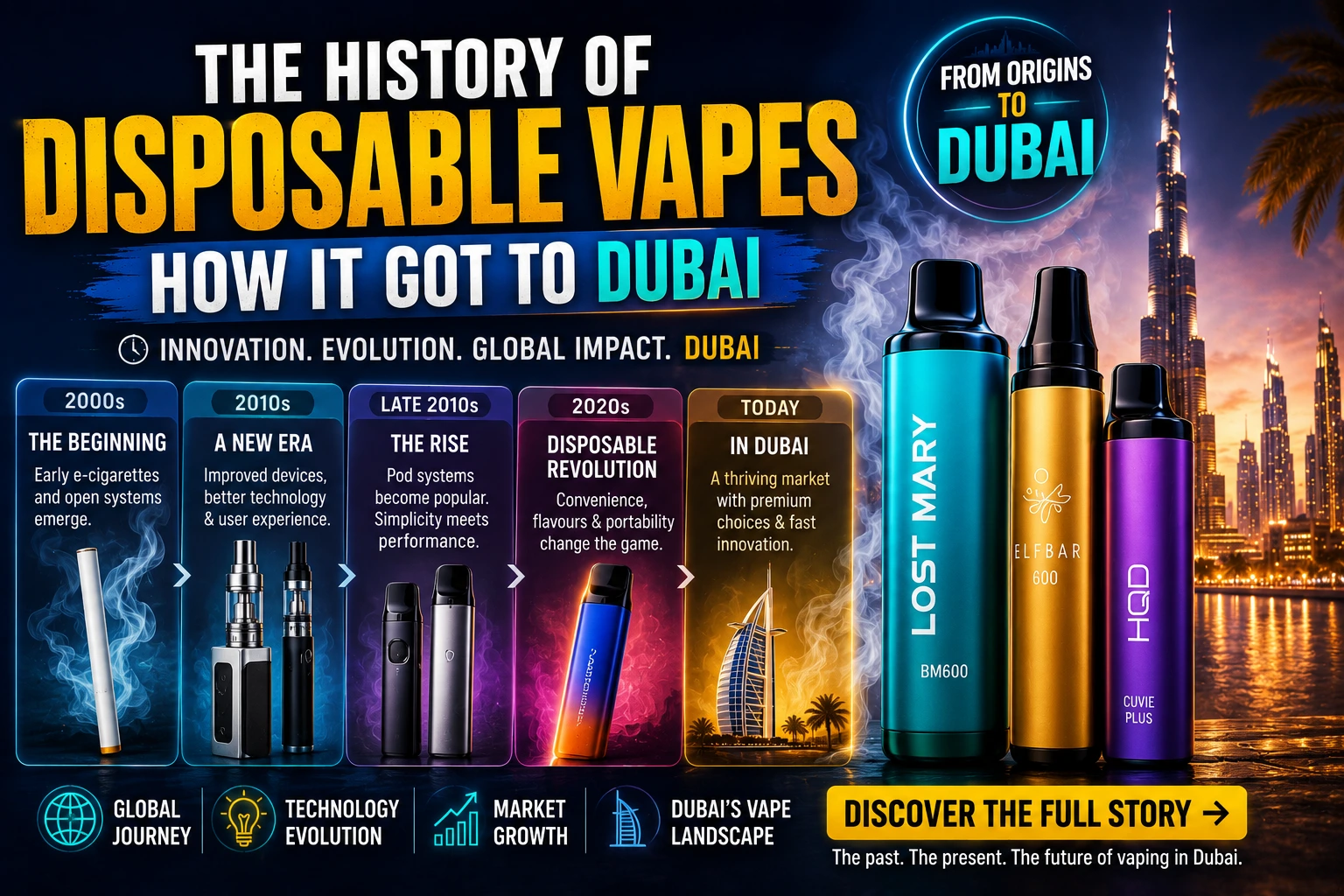
Walk into any vape shop in Dubai today, and you will see walls of disposable devices — sleek, colorful, capable of thousands of puffs from a single unit. It is easy to assume this is a recent invention, something that appeared alongside the smartphone era and has not changed much since. The reality is considerably older and more interesting than that.
The story of the disposable vape spans more than sixty years, multiple countries, a failed 1960s prototype, a grieving Chinese pharmacist, and a regulatory shift in the UAE that turned Dubai into one of the most active vape markets in the Middle East. Understanding that history is not just trivia — it explains why the devices on Vapor Club’s shelves today look and perform the way they do.
The First Attempt: 1963 and Herbert Gilbert’s Forgotten Invention
The idea of a smokeless cigarette did not begin with sleek mesh coils and nicotine salts. It began in 1963, when an American inventor named Herbert A. Gilbert filed a patent for what he called a “smokeless non-tobacco cigarette.”
Gilbert’s design used a battery to power a heating element that warmed a flavored cartridge, producing vapor without combustion — no smoke, no ash, no burning tobacco. In concept, this is remarkably close to what a disposable vape does today. The problem was timing. Compact, high-capacity batteries did not exist yet, and the market in the 1960s had little appetite for an alternative to traditional cigarettes. Gilbert’s invention was patented but never reached commercial production.
It would sit largely forgotten for four decades. But the blueprint it established — a battery, a heating element, a flavored liquid, an inhalable vapor — is the same basic architecture every disposable vape uses today, including the ones sold through Vapor Club’s disposable vape collection.
The Breakthrough: Hon Lik and the Birth of the Modern E-Cigarette
The device that actually launched the global vaping industry came forty years later, and from a deeply personal motivation.
In 2003, Hon Lik, a Chinese pharmacist, developed the first commercially successful electronic cigarette after losing his father to lung cancer caused by heavy smoking. Working through a company that would later become known as Ruyan, Hon Lik built a device using ultrasonic technology to vaporize a nicotine-containing liquid solution — a genuine alternative to combustion that mimicked the physical experience of smoking while eliminating the burning tobacco at the center of it.
The device launched commercially in China in 2004 and reached the UK market between 2005 and 2007, marking the beginning of vaping as a global consumer category rather than a regional curiosity. From there, growth was steady through the late 2000s and accelerated significantly through the 2010s as tank systems, refillable pods, and increasingly sophisticated devices entered the market.
From Refillable Tanks to True Disposables: The Missing Piece
Early e-cigarettes, including Hon Lik’s original design, required refilling and maintenance — closer to what we would now call a vape pen or pod system than a disposable. The genuinely single-use disposable vape, designed to be used until empty and then discarded, emerged as a distinct product category somewhat later.
One of the earliest disposable attempts came in 2004 with a product called the “Exhale,” produced by a company called Smoking Everywhere. It was not a major commercial success, but it represented the first real attempt at the format that would eventually dominate the market: pre-filled, no maintenance, no refilling, just draw and discard.
The format did not take off immediately. What changed everything was a development in the e-liquid itself, not the hardware.
The Nicotine Salt Revolution — Why 2015 Changed Everything
If there is a single turning point that explains why disposable vapes became the dominant format rather than a niche product, it is the introduction of nicotine salt e-liquid around 2015.
Traditional freebase nicotine — the kind used in early e-cigarettes — becomes harsh and difficult to inhale at higher concentrations. This limited how much nicotine a device could realistically deliver in a smooth, satisfying way. Nicotine salt, formed by combining nicotine with an organic acid, lowers the pH of the e-liquid and produces a dramatically smoother throat hit even at high nicotine concentrations.
This single chemistry change made it possible to build small, simple, pre-filled devices that delivered cigarette-equivalent nicotine satisfaction without the harshness that had limited earlier disposables. It is the direct reason a modern device like the Elf Bar BC5000 can comfortably deliver 50mg nicotine salt where an equivalent freebase concentration would be nearly unusable.
From 2015 onward, disposable vape technology accelerated quickly: mesh coils replaced basic wire coils for better flavor consistency, battery capacities increased, puff counts climbed from the low hundreds into the thousands, and USB-C rechargeable disposables solved the wasted-battery problem that had limited earlier single-use devices.
How Vaping Reached the UAE — The Regulatory Turning Point
For years, the UAE’s relationship with vaping looked very different from what it is today. Before 2019, e-cigarettes were illegal in the United Arab Emirates, even as unregulated use was rising steadily across the region.
That changed in April 2019, when the UAE became the first country in the Middle East to approve formal standards for nicotine electronic cigarettes, administered through the Emirates Authority for Standardization and Metrology (ESMA). This was not a quiet regulatory footnote — it was a deliberate move to bring an already-growing underground market into a regulated, accountable framework, covering everything from technical specifications and ingredients to imports, packaging, and labeling requirements.
The UAE’s approach quickly became a regional model. By the early 2020s, the regulatory clarity ESMA provided was being cited as a blueprint for other Gulf and Middle Eastern markets developing their own vaping policies, including Saudi Arabia, Kuwait, and Jordan.
The practical effect for Dubai specifically was significant: legal certainty meant legitimate businesses could open, import authentic stock, and build retail operations without operating in a legal gray zone. The 2021 Dubai World Vape Show became the region’s first dedicated e-cigarette trade exhibition, and by its 2022 edition, attendance had grown by 50 percent year over year — a clear signal of how quickly the legitimate UAE vape market was expanding once the regulatory foundation was in place.
Dubai’s Vape Market Today — Built on That 2019 Foundation
Everything available through Vapor Club’s catalog today exists because of that 2019 shift. The UAE vape market has continued growing at a steady pace in the years since, with industry tracking placing annual market growth in the UAE at roughly 7 percent — driven by a combination of regulatory clarity, expanding product variety, and growing acceptance of vaping as a smoking alternative among UAE residents.
What makes Dubai’s market distinctive within the broader Middle East is the breadth of what is legally available. ESMA-compliant disposable vapes, pod systems, and e-liquids are sold openly through licensed retailers both in physical shops and online — a level of accessibility that several neighboring markets, where vaping remains banned or heavily restricted, simply do not have.
The devices that fill Dubai’s vape shelves today — high-puff rechargeable disposables, mesh coil technology, nicotine salt formulas at multiple strengths — represent the cumulative outcome of six decades of incremental invention: Gilbert’s 1963 concept, Hon Lik’s 2003 breakthrough, the 2015 nicotine salt revolution, and the UAE’s 2019 regulatory framework that made legitimate retail possible in the first place.
What This History Means for Buyers Today
Understanding where disposable vapes came from is not just background trivia — it explains a few things that matter practically when you are choosing a device in Dubai today.
Why nicotine salt dominates the UAE market. It is not a marketing trend; it is the chemistry breakthrough that made modern disposables viable in the first place. Most devices sold legally in Dubai use nicotine salt formulations specifically because of this 2015-era shift.
Why ESMA compliance matters. The 2019 regulatory framework exists because the UAE government recognized that an unregulated vape market carried real risks — inconsistent products, unverified ingredients, no accountability. Buying ESMA-compliant products from a licensed retailer like Vapor Club connects you to that regulatory protection.
Why the technology keeps improving. Mesh coils, rechargeable batteries, higher puff counts — these are not arbitrary feature additions. Each represents a specific technical problem solved since the disposable format first emerged commercially in the mid-2000s.
For a deeper look at how today’s terminology and technical specifications work, the glossary of vape terms covers the language that has developed across this sixty-year history in plain, practical terms.
Final Word
The disposable vape sitting on a shelf at Vapor Club today carries sixty years of invention behind it — a forgotten 1963 patent, a grieving pharmacist’s breakthrough in 2003, a chemistry shift in 2015 that made modern nicotine salt formulas possible, and a 2019 regulatory decision that turned the UAE into one of the region’s most developed vape markets.
None of that history is necessary to enjoy a good device. But knowing it explains why today’s options are as advanced, varied, and reliable as they are.
Explore the current generation of that history at Vapor Club’s disposable vapes collection — built on six decades of innovation, sold within a regulatory framework designed to keep it safe.
Frequently Asked Questions
When was the first disposable vape invented?
The conceptual blueprint dates to 1963 with Herbert A. Gilbert’s patented smokeless cigarette, though it was never produced commercially. The first true disposable-format products emerged in the mid-2000s, following Hon Lik’s 2003 commercial e-cigarette breakthrough.
Who is considered the inventor of the modern vape?
Hon Lik, a Chinese pharmacist, is widely credited with inventing the modern commercially successful e-cigarette in 2003, motivated by his father’s death from smoking-related lung cancer.
When did vaping become legal in the UAE?
Vaping became legal in the UAE in April 2019, when the Emirates Authority for Standardization and Metrology (ESMA) approved formal product standards for nicotine electronic cigarettes.
Why did nicotine salt change the disposable vape industry?
Nicotine salt, introduced into the e-liquid market around 2015, allowed much higher nicotine concentrations to be inhaled smoothly. This made small, simple, pre-filled disposable devices genuinely viable as cigarette alternatives for the first time.
How big is the vaping market in the UAE today?
Industry tracking has placed the UAE vape market growth at approximately 7 percent annually in recent years, driven by regulatory clarity from ESMA, expanding product variety, and rising consumer acceptance across Dubai and the wider Emirates.