
Nicotine Pouches UAE Guide 2026: Laws, ESMA & Safety Explained

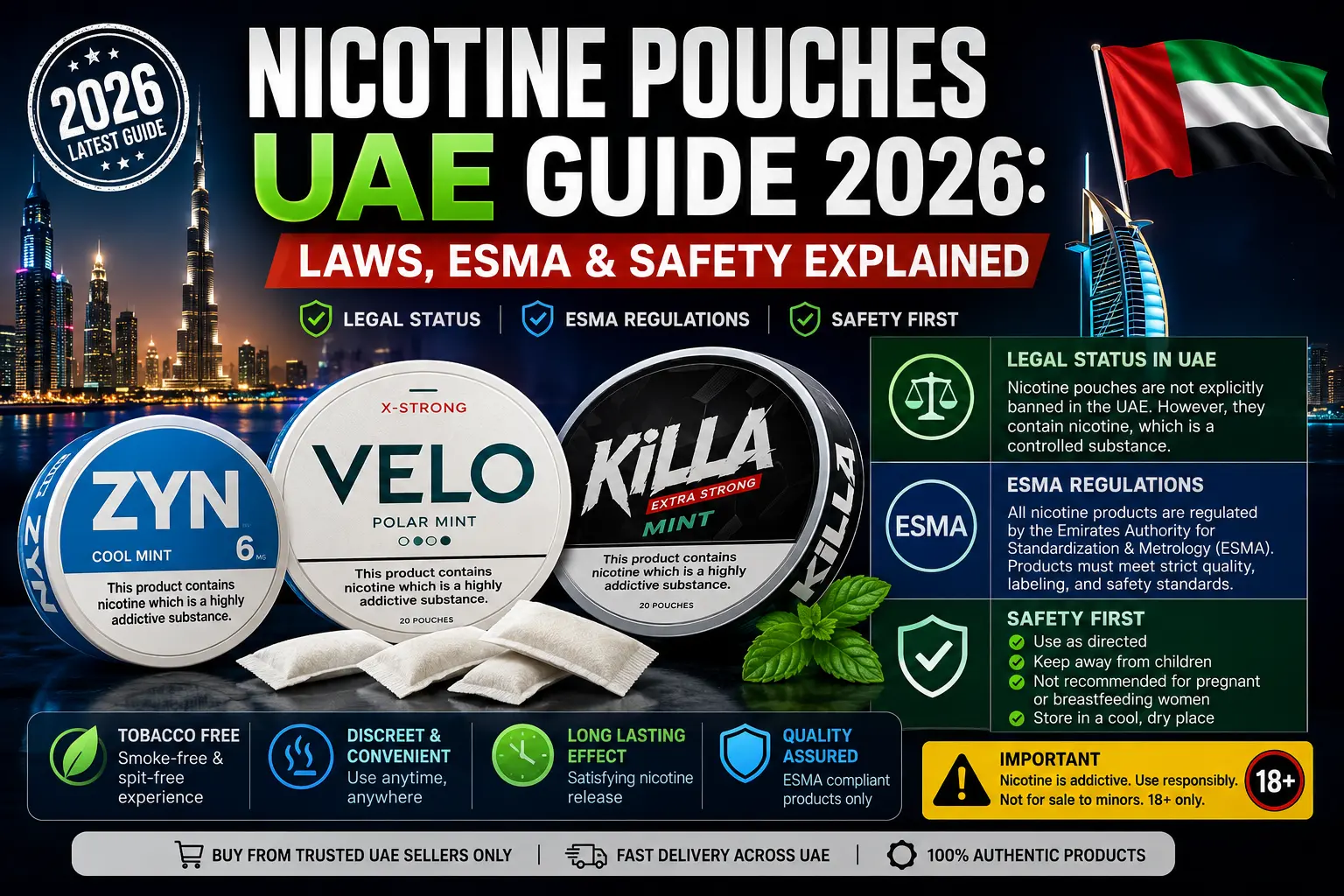
Quick answer: Yes — tobacco-free nicotine pouches are legal to buy and use in the UAE in 2026 if you are 18 or older and the product is certified under the UAE’s technical regulation for tobacco-free nicotine pouches, with nicotine content capped at 16.6 mg per pouch and bilingual Arabic/English warning labels. Buying from an unlicensed seller or an uncertified import is where people get into trouble, not the product itself.
Last updated: 16 July 2026 · Reviewed by VaporClub’s compliance desk against UAE Cabinet Resolution sources, MoIAT and Federal Tax Authority guidance.
Nicotine pouches went from a grey-area product to one of the most clearly regulated nicotine categories in the Gulf in the space of about three years. That’s good news for buyers, but it also means the “rules” you read about in a 2022 forum post or a 2024 Instagram caption are already out of date. This guide sets out exactly where things stand in 2026 — who regulates the category, what the law actually requires, how to tell a compliant can from a risky one, and what happens at customs if you’re traveling with pouches.
Nothing here is legal or medical advice. It’s a plain-English explanation of publicly available UAE regulation, written for adult consumers who want to buy with confidence.
What Exactly Is a Nicotine Pouch?
A nicotine pouch is a small, pre-portioned white pouch that sits between your upper lip and gum. It contains pharmaceutical-grade nicotine, plant-based fibre, sweeteners and flavouring — and, critically, no tobacco leaf. There’s no combustion, no vapour and no smoke, which is why regulators treat pouches as a distinct “novel product” category rather than lumping them in with cigarettes or vapes.
This distinction matters legally. Snus — the traditional Swedish product that does contain tobacco leaf — is treated differently under UAE law and its import is restricted. Tobacco-free nicotine pouches are not the same product, and confusing the two is one of the most common mistakes buyers make when researching legality.
If you want to see how pouches compare to disposable vapes and e-liquids for everyday use, our nicotine pouches category page breaks down strength and format side by side.
Are Nicotine Pouches Legal in the UAE?
Yes. As of 2026, tobacco-free nicotine pouches are legal for adults aged 18 and over across all seven emirates, provided the product:
- Is certified under the UAE’s technical regulation for tobacco-free nicotine pouches
- Does not exceed the nicotine concentration cap
- Carries bilingual Arabic and English labelling with a visible nicotine warning
- Is sold by a licensed retailer, not an unregistered importer or reseller
The product category itself was never “banned then legalised overnight” the way some outdated articles suggest — it went through a multi-year certification process, formalised in stages between 2019 and 2026, as described in the timeline below.
Who Regulates Nicotine Pouches in the UAE
A single body doesn’t handle the regulation of nicotine products in the UAE. It’s a tiered system, and knowing who does what helps explain why some sources contradict each other online.
| Authority | Role |
|---|---|
| MoIAT (Ministry of Industry and Advanced Technology) | Oversees technical certification and product standards through the Emirates Conformity Assessment Scheme (ECAS). Took over primary technical oversight of nicotine products from ESMA. |
| ESMA (Emirates Authority for Standardization and Metrology) | Historically issued the standardization framework nicotine products are certified against; still referenced in product-standard documentation and labelling checks. |
| Federal Tax Authority (FTA) | Manages excise tax and digital tax stamps on nicotine products, used to trace legitimate supply chains and curb smuggling. |
| Dubai Municipality / local emirate authorities | Handle local retail licensing and enforcement, including where products can be sold and displayed. |
| MOHAP (Ministry of Health and Prevention) | Sets health-claim restrictions — nicotine pouches cannot be marketed as smoking-cessation or medical products without separate health-product approval. |
In short: MoIAT and ESMA cover what’s in the can and on the label, the FTA covers whether tax has been paid on it, and local authorities cover who’s allowed to sell it to you.
The Law in Detail: What the Regulation Actually Requires {#the-law}
The core legal instrument here is the UAE Cabinet Resolution on the technical regulation for tobacco-free nicotine pouches, which sets out the requirements every compliant product must meet:
Nicotine content cap. Pouches sold in the UAE must not exceed 16.6 mg of nicotine per pouch. This is a hard ceiling, not a marketing suggestion — products advertised above this level through unofficial channels fall outside the regulation.
Certification mark. Compliant products carry an ECAS or MoIAT conformity mark on the outer packaging, confirming the product has passed the required technical assessment.
Bilingual labelling. Every pack must display a clear Arabic-language nicotine warning alongside the English version, plus ingredient disclosure and the exact mg-per-pouch figure.
Age restriction. Sale to anyone under 18 is prohibited, and licensed retailers are expected to verify age at the point of sale.
No health claims. Products cannot be marketed as cessation aids, “safer than smoking” in absolute medical terms, or any kind of therapeutic product — that positioning is reserved for MOHAP-approved nicotine replacement therapies like patches, gum and lozenges, which are a separate regulatory category entirely.
No public-place use in restricted areas. As with vaping, use of nicotine pouches in certain public and enclosed spaces is restricted under general tobacco-control rules, even though pouches produce no visible smoke or vapour.
How UAE Nicotine Pouch Regulation Evolved (Timeline)
Understanding the timeline helps explain why older articles you might find online give conflicting answers.
- 2019 — ESMA introduces the first formal framework legalising approved e-cigarettes and e-liquids, ending the previous grey-area status for vaping devices.
- 2023–2024 — Nicotine pouches grow rapidly in the regional market. Regulators begin work on a dedicated technical standard, distinct from e-cigarette rules, to address the category specifically.
- Mid-2025 — The Cabinet Resolution on the technical regulation for tobacco-free nicotine pouches is finalised, formally bringing pouches under ECAS/MoIAT certification with a defined nicotine cap and labelling rules.
- 2026 — Enforcement matures. Digital tax stamps and stricter import checks target unregistered, ultra-strength pouches entering through informal channels, while certified mainstream brands operate under clear, stable rules.
The direction of travel has been consistent: more structure, not less. The UAE’s approach positions certified tobacco-free nicotine as a regulated harm-reduction category sitting between cigarettes and pharmaceutical NRT — legal, but not unrestricted.
How to Check a Pouch Is Legally Compliant Before You Buy
Before you tap “buy” or hand over cash on delivery, run through this checklist:
- The retailer is licensed. Buy from a UAE-registered retailer with a real trade licence — not an anonymous social media account or an overseas courier listing.
- Arabic warning label is present. A compliant can will always carry the Arabic nicotine warning alongside the English text.
- The conformity mark is visible. Look for the ECAS or MoIAT mark on the packaging.
- Nicotine content is disclosed in mg per pouch and sits at or below the 16.6 mg cap.
- No medical or cessation claims on the packaging or in the marketing — a compliant product will not call itself a “quit smoking” device.
- Batch or traceability code is printed on the can, allowing the product to be traced back through the supply chain.
If a listing is missing more than one of these, treat it as a red flag rather than a bargain. Our full nicotine pouches buying guide walks through strength selection and flavour differences once you’ve confirmed a product is compliant, and the best nicotine pouches in Dubai 2026 roundup compares specific brands stocked under these standards.
Traveling and Customs: Bringing Pouches Into the UAE
A reasonable quantity of nicotine pouches for personal use is generally permitted when entering the UAE, but a few practical rules keep travelers out of trouble:
- Keep pouches in their original, sealed packaging with visible labelling.
- Declare them if asked by customs officers — don’t volunteer anything and hope it doesn’t come up.
- Avoid carrying bulk stock or unlabeled tins bought from unofficial overseas sellers; this is what typically triggers extra inspection, not the product category itself.
- Check your airline’s specific carriage policy before flying, since airline rules can be stricter than the underlying customs regulation.
- Buying in-country from a licensed UAE retailer after arrival avoids the question entirely — which is the simpler option for most residents and tourists.
Myths vs Facts
Myth: “Nicotine pouches and snus are the same thing, so if one is legal the other is too.” Fact: Snus contains real tobacco leaf; nicotine pouches are tobacco-free. They are regulated as separate categories, and snus faces tighter import restrictions in the UAE than tobacco-free pouches.
Myth: “If it’s tobacco-free, there’s no upper limit on nicotine strength.” Fact: The regulation caps nicotine at 16.6 mg per pouch regardless of whether tobacco is present. “Extra strong” products advertised above that level through unofficial channels aren’t operating within the certified framework.
Myth: “A product marketed as helping you quit smoking must be safer and more heavily regulated.” Fact: It’s the opposite. Making a cessation or medical claim without MOHAP approval is non-compliant — legitimately certified pouches are marketed as a consumer nicotine product, not a health product.
Myth: “Buying from an overseas website is fine as long as it’s for personal use.” Fact: Personal-use import allowances exist for quantity, but the product must still meet UAE certification standards to avoid issues at customs or in day-to-day possession.
What Happens If a Product Isn’t Compliant
Selling nicotine pouches without a valid retail licence, distributing uncertified or unregistered products, or making unauthorized health claims can result in confiscated stock, fines, and licence issues for the retailer involved. For buyers, the practical risk is different: uncertified products bought from unlicensed sources aren’t held to any verified nicotine-content or ingredient standard, so you genuinely don’t know what’s in the pouch. That’s the real-world reason to stick to certified products from licensed sellers — not because of a technicality, but because the certification is the only thing standing between you and an unverified product.
FAQs
Is it legal to buy nicotine pouches online in the UAE?
Yes, provided the online retailer is UAE-licensed, and the products carry MoIAT/ECAS certification, bilingual labelling and a nicotine content at or below 16.6 mg per pouch.
What’s the maximum nicotine strength allowed per pouch in the UAE?
16.6 mg per pouch is the regulatory cap under the current technical standard.
Do I need to be a resident to buy nicotine pouches in the UAE?
No — the requirement is age (18+), not residency status. Tourists can legally purchase from licensed retailers.
Is snus legal in the UAE?
Traditional tobacco-containing snus faces significantly tighter import restrictions than tobacco-free nicotine pouches. If a product is described as “snus” but is tobacco-free, it’s technically a nicotine pouch by the UAE’s regulatory definition.
Can nicotine pouches be marketed as a way to quit smoking in the UAE?
No, not without separate MOHAP approval as a medical/cessation product. A compliant consumer nicotine pouch will not carry that claim on its packaging.
Who enforces nicotine pouch regulations in the UAE — ESMA or MoIAT?
MoIAT now holds primary responsibility for technical certification (ECAS), with ESMA’s earlier standardization framework still forming part of the underlying product standard. The Federal Tax Authority separately manages excise tax compliance.
Sources
This guide was compiled with reference to the UAE Cabinet Resolution on the technical regulation for tobacco-free nicotine pouches (UAE Legislation portal), public guidance referencing MoIAT’s Emirates Conformity Assessment Scheme (ECAS), Federal Tax Authority excise tax guidance on nicotine products, and reporting on the UAE’s 2025 approval of tobacco-free nicotine pouch sales. Regulatory status can change with limited notice — always verify current requirements with UAE Government sources or a licensed retailer before purchasing or importing.
This article is for general informational purposes only and does not constitute legal or medical advice. Nicotine is an addictive substance. Products discussed are intended for adults aged 18 and over.
This is really interesting, You’re a very skilled blogger. I’ve joined your feed and look forward to seeking more of your magnificent post. Also, I’ve shared your site in my social networks!
Very well presented. Every quote was awesome and thanks for sharing the content. Keep sharing and keep motivating others.
Hi there to all, for the reason that I am genuinely keen of reading this website’s post to be updated on a regular basis. It carries pleasant stuff.
I very delighted to find this internet site on bing, just what I was searching for as well saved to fav
I am truly thankful to the owner of this web site who has shared this fantastic piece of writing at at this place.
You’re so awesome! I don’t believe I have read a single thing like that before. So great to find someone with some original thoughts on this topic. Really.. thank you for starting this up. This website is something that is needed on the internet, someone with a little originality!
There is definately a lot to find out about this subject. I like all the points you made
very informative articles or reviews at this time.