
Vaping Laws in UAE 2026 – Everything You Need to Know

If you searched “vaping laws UAE,” you probably found ten articles that all say the same thing: legal since 2019, ECAS certified, 20mg/ml nicotine cap, don’t vape in malls. True, but incomplete. What almost none of them explain clearly is where nicotine vaping law actually stops and UAE narcotics law begins, what the real fine looks like broken down by location, and how the “one vape equals 20 cigarettes” claim actually holds up under UAE’s own nicotine limits. This guide covers all of it, with the underlying laws named so you can verify them yourself.
Is Vaping Legal in the UAE in 2026? The Short Answer
Yes. Vaping has been legal across the UAE, including Dubai, Abu Dhabi, and Sharjah, since April 2019, when the Cabinet lifted the earlier ban on e-cigarettes. It sits under Federal Law No. 15 of 2009 on Tobacco Control, the same statute that governs traditional cigarettes, which is why vapes follow near-identical rules to smoking rather than having their own separate legal category. Legal status is conditional on three things: the product must be officially certified, the user must be 18 or older, and the location must be one where smoking itself is permitted. Miss any one of those three and a perfectly legal device becomes the basis for a fine.
The Legal Framework Most Guides Skip Over
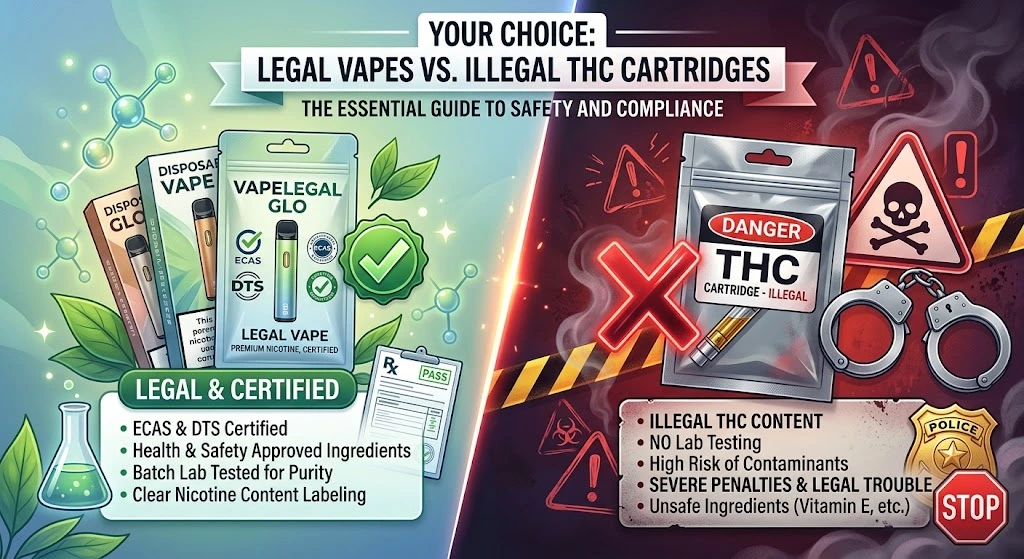
Here’s the part that gets glossed over: vaping in the UAE was never given its own dedicated law. It was folded into the existing 2009 Tobacco Control Law, with the technical certification side handled first by the Emirates Authority for Standardization and Metrology (ESMA) and now by the Ministry of Industry and Advanced Technology (MoIAT) through the Emirates Conformity Assessment Scheme, known as ECAS. Practically, this means any device or e-liquid sold or used in the UAE needs a valid ECAS conformity mark before it’s legal, full stop. Because vaping shares its legal backbone with cigarette law rather than standing alone, any future amendment to UAE tobacco control (packaging rules, advertising restrictions, GCC-wide standards) automatically extends to e-cigarettes too — which is exactly what’s been happening with the recent rollout of Digital Tax Stamps (DTS) on vape packaging, a requirement most consumer guides don’t mention because it’s aimed at businesses, not shoppers. As a buyer, the DTS sticker and the ECAS mark together are your two-second way to check a product is genuine before you pay for it. If you’re shopping for something specific, our disposable vapes Dubai collection only lists stock that meets these requirements, which is worth knowing given how much unregistered product still circulates through informal sellers.
Nicotine Limits and What Actually Makes a Vape “Legal”
This is where the gap between UAE law and what’s actually sold on the street becomes obvious. Under ECAS/GCC technical standards, e-liquids sold legally in the UAE are capped at 20mg/ml (2%) nicotine strength, and pods or tanks are capped at 2ml capacity. That means the 5% (50mg/ml) salt-nic pods and disposables that dominate the US and parts of Asia are, technically, not compliant for UAE retail unless a manufacturer has specifically certified a higher-strength variant, which is rare. A huge share of “grey market” disposables sold by unlicensed kiosks and social-media sellers in Dubai and Sharjah sit above this cap. That’s not a small technicality — it directly affects how much nicotine you’re actually absorbing per session, which matters for the cigarette-comparison question later in this guide. Before buying anything, it’s worth reading through how counterfeit devices get past casual buyers in our breakdown of original vs fake disposable vapes in the UAE, since fake stock is almost always where the nicotine cap gets ignored entirely.
Where You Can and Cannot Vape in the UAE
The rule of thumb UAE authorities apply is simple: if a location bans cigarette smoking, it bans vaping too. There is no separate, more relaxed category for e-cigarettes.
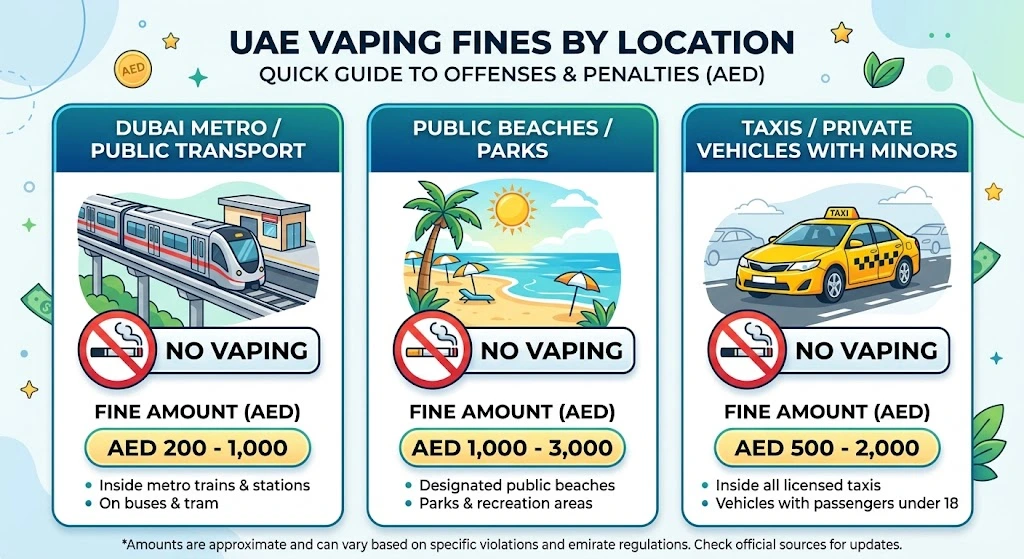
Vaping is prohibited in shopping malls, supermarkets, cinemas, restaurants and cafés without a licensed smoking section, government buildings, hospitals and clinics, schools and universities, mosques, and all public transport including the Dubai Metro, buses, taxis, and airport terminals. It’s also banned on public beaches and in parks unless a space is explicitly marked as a smoking area, and inside a private vehicle when a child under 12 is present.
Vaping is generally permitted in designated outdoor smoking areas at hotels, malls and commercial venues, licensed vape lounges and shisha cafés, and private outdoor spaces like a villa garden or balcony.
Real fines for real violations, by location:
| Violation | Typical Fine |
|---|---|
| Vaping in a banned enclosed public space (first offence) | AED 500–1,000 |
| Repeat offence in a banned space | AED 2,000+ |
| Vaping on the Dubai Metro, tram, or bus | AED 2,000 |
| Vaping in a taxi | AED 500 |
| Vaping on a public beach | AED 500 |
| Vaping in a vehicle with a child under 12 present | AED 5,000+ |
| Retailer selling to a minor | Up to AED 100,000 |
Can I Take My Vape on Emirates? Flight and Airport Rules Explained
Every UAE-based carrier — Emirates, Etihad, flydubai, and Air Arabia — follows the same core rule: your vape device and any spare batteries must travel in your carry-on bag, never in checked luggage. This isn’t a UAE-specific quirk; it follows global aviation safety rules from IATA and the UAE’s General Civil Aviation Authority, because lithium-ion batteries are treated as a fire risk in an unpressurised, unmonitored cargo hold. Emirates’ own dangerous goods policy specifically lists e-cigarettes, e-cigars, e-pipes and personal vaporisers as carry-on-only items that must be individually protected against accidental activation.
A few practical details that trip travellers up: you cannot use or charge your vape at any point during the flight, even in the lavatory. E-liquids follow the standard 100ml-per-container liquid rule and need to go in your clear resealable bag alongside other liquids. You also can’t vape anywhere inside a UAE airport terminal outside the designated smoking lounges found in every terminal before security. If you’re travelling with a specific device, something like the Elf Bar BC10000 or similar sealed disposable is generally easier to carry through security than an open-system mod, since there’s nothing to leak and no separate battery to declare.
Where Vaping Law Ends and Drug Law Begins: THC Cartridges Are a Different Universe
This is the single most important distinction almost every “vaping laws UAE” article fails to draw clearly, and it’s the one that has landed real people in real prison. Standard nicotine e-liquids and disposables are governed by tobacco control law — a regulatory, fine-based system. THC and CBD-with-THC vape cartridges are governed by an entirely separate body of law: Federal Decree-Law No. 30 of 2021 on Combating Narcotics and Psychotropic Substances, and the UAE enforces it with a genuine zero-tolerance standard.
In practice, that means possession of any quantity of a THC cartridge — even what a traveller assumes is a “wellness” CBD vape bought legally at home — can trigger prosecution, because UAE law doesn’t distinguish between recreational and incidental possession the way some other countries do. Trace amounts detected through blood or urine testing count as evidence of the offence, regardless of where or when the substance was actually used. First-time personal use or possession carries a minimum of three months’ imprisonment or a fine of AED 20,000 to AED 100,000 under Article 41 of the decree-law, with courts sometimes diverting first offenders to treatment instead. Trafficking-level quantities are treated far more severely; UAE courts have handed down decades-long sentences in cases where cartridges were found in bulk, and the law allows for the death penalty in aggravated trafficking cases. If you’re deciding what disposable to bring into the country or buy locally, the legal line isn’t “is it a vape” — it’s “does it contain THC,” and that single word changes which law applies entirely.
Is a Vape Really Equal to 20 Cigarettes? The Real Math
This is one of the most searched vaping questions worldwide, and the honest answer is: it depends, and the UAE’s own nicotine cap actually changes the calculation. A single cigarette delivers roughly 1–2mg of absorbed nicotine. A pack of 20 therefore delivers somewhere around 20–40mg total. A legally compliant UAE e-liquid at the 20mg/ml ceiling typically delivers about 1mg of nicotine per puff, meaning it takes roughly 15–25 puffs to match the nicotine absorbed from one cigarette — not one puff, and not the whole device.
Where the “20 cigarettes” comparison becomes more accurate is at the device level, not the puff level. A large-capacity disposable rated for several thousand puffs, used at an ECAS-compliant 20mg/ml strength, can realistically contain a cumulative nicotine load comparable to multiple packs of cigarettes over its lifespan. That’s a fair comparison. What isn’t fair — and what most sites don’t flag — is that black-market disposables sold above the legal 20mg/ml cap (the 5%/50mg versions common outside licensed UAE retail) push that comparison significantly higher per session than a compliant product would, simply because they’re delivering more than double the nicotine per puff that UAE regulation actually permits. It’s a genuine health-and-legal argument for sticking to ECAS-certified stock rather than an unregulated import, something like the Al Fakher Crown Bar 15000 Puffs HyperMax being a compliant example of a high-capacity device sold within the legal nicotine ceiling.
Age Restrictions and Rules for Sellers
The legal age to buy or use a vaping product anywhere in the UAE is 18. Retailers are required to verify ID before selling, and enforcement here is genuinely strict — a shop caught selling to a minor faces fines up to AED 100,000, alongside potential license action. This applies to online sellers too; age-gating at checkout isn’t just good practice, it’s a compliance requirement.
How to Actually Check a Vape Is Legally Compliant Before You Buy
Given how much non-compliant stock still circulates, a simple pre-purchase checklist is more useful than most guides admit:
- Look for the ECAS conformity mark on the packaging.
- Check for a Digital Tax Stamp (DTS) — a small stamp that confirms the product has been registered and taxed correctly.
- Confirm the nicotine strength is listed at 20mg/ml or below.
- Confirm tank or pod capacity doesn’t exceed 2ml.
- Buy from a licensed retailer rather than an unregistered kiosk or social media seller.
If you’d rather browse a catalogue that’s already filtered for this, our full disposable vapes Dubai range is a straightforward place to start, and devices like the Al Fakher 60K Puffs E-Hose X Hookah are examples of newer, higher-capacity formats built around the same compliance standards covered in this guide.
Frequently Asked Questions
Is it legal to vape in the UAE?
Yes. Vaping has been legal across the UAE since April 2019 under Federal Law No. 15 of 2009 on Tobacco Control, provided the user is 18 or older, the product carries valid ECAS certification, and it’s used somewhere smoking itself is permitted.
Is a vape equal to 20 cigarettes?
Not per puff. A cigarette delivers roughly 1–2mg of absorbed nicotine, and it takes about 15–25 puffs of a UAE-compliant 20mg/ml e-liquid to match that. Over the full lifespan of a large-capacity disposable, the cumulative nicotine can add up to something comparable to multiple packs — but the “one vape, 20 cigarettes” claim is more accurate as a device-lifetime comparison than a single-session one, and it gets worse with non-compliant, above-cap black-market devices.
Can I take my vape on Emirates?
Yes. Emirates allows vaping devices in carry-on baggage only, never in checked luggage, and batteries must be individually protected against accidental activation. You cannot use or charge the device at any point during the flight.
Can I carry a vape in flight?
Yes, on all major UAE carriers, as long as it stays in your cabin bag rather than checked luggage. This applies across Emirates, Etihad, flydubai, and Air Arabia, and is a global aviation safety rule tied to lithium-ion battery risk, not a UAE-specific restriction.
Final Word
UAE vaping law is more layered than the average “is vaping legal” article suggests. Nicotine vaping itself is a well-regulated, legal, 18+ product category with clear rules on where you can use it and how it must be certified. The real risk isn’t nicotine vaping at all — it’s confusing it with THC cartridges, which fall under an entirely separate, zero-tolerance narcotics law with genuinely severe consequences. Stick to ECAS-certified, DTS-stamped nicotine products from a licensed UAE retailer, respect the location rules, and vaping in the UAE in 2026 remains exactly what the law intends it to be: legal, boring, and low-risk.